Price the Rules First: A 2026 Live Blackjack Table Audit for US Players
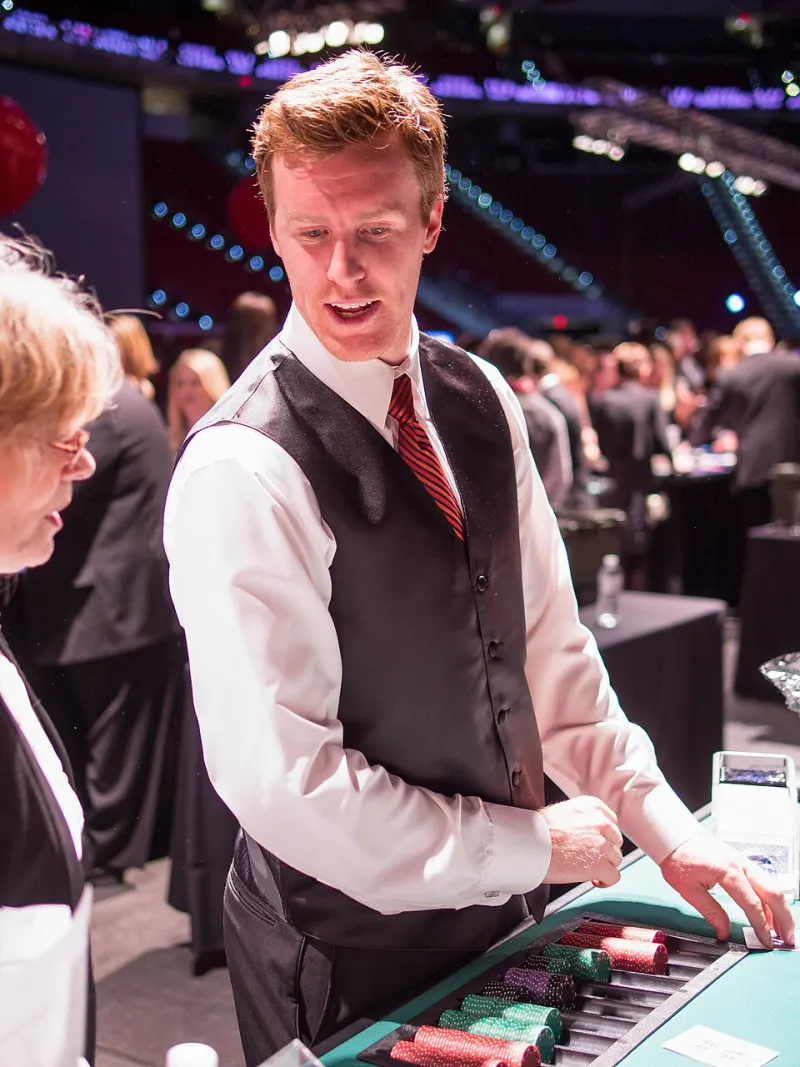
Photo: Benjamin Reed, CC BY-SA 2.0, via Wikimedia Commons
Live blackjack looks like one game. It is not. Two tables can carry the same $10 minimum, the same friendly dealer, and the same fake-leather background, then pay you differently on the exact same winning hand. In 2026, the rule card is the line. If you would not bet a football game without checking the number, do not buy into a live blackjack table without checking the fine print.
This is not about memorizing basic strategy. It is about pricing the table before you sit. Four rules do most of the damage: a 6:5 blackjack payout, a dealer who hits soft 17, no surrender, and no double after split. None of them feel dramatic in the moment. Together they can turn a playable game into a slow leak.
Why the Rule Card Beats the Table Minimum
A low minimum is a marketing number. The rule set is the actual price. A $5 table with 6:5 payouts and no double after split can cost more per hour than a $25 table with 3:2 payouts, dealer stands on soft 17, late surrender, and double after split. The minimum controls how much you can lose on one hand. The rules control how much you lose across 70 hands.
That distinction matters more in live dealer blackjack than in most casino games because the table is slow enough to feel casual. You are not pressing a button every three seconds. You are chatting, watching cards, sipping something. The relaxed pace hides the fact that every hand is still being priced. Rule shopping is how you make sure the price is fair.
The Four Levers That Move Your Hourly Cost
1. 6:5 versus 3:2
A natural blackjack at 3:2 pays $15 on a $10 bet. At 6:5 it pays $12. That $3 gap looks small. At 70 hands an hour, with a natural roughly once every 21 hands, you will see about three or four naturals per hour. Three dollars times three or four is $9 to $12 an hour, before the house edge on every other hand. In edge terms, 6:5 adds roughly 1.4% to the house edge compared with 3:2. That is the difference between a close game and a carnival game.
2. Dealer hits soft 17
When the dealer hits soft 17, the house gains about 0.2%. It is smaller than the 6:5 hit, but it is always on. Over a long session, 0.2% on $1,750 of hourly action is $3.50 an hour. Not fatal. Still real. If you are choosing between two otherwise similar tables, dealer stands on soft 17 is the tiebreaker.
3. Late surrender
Surrender lets you fold half your bet on bad starting hands. It is worth about 0.08% to the player when used correctly. That sounds tiny. It is also a pressure valve. Without it, you stay in more losing hands. With it, you cut variance and shave the edge. A table that offers surrender and a table that does not are not the same product.
4. Double after split
Double after split lets you double after splitting a pair. It is worth roughly 0.14% to the player. Again small. Again cumulative. A table without double after split is not unplayable, but it is a table you should price lower.
A Simple Hourly-Loss Estimate
Use this formula:
Hourly expected loss = average bet × hands per hour × house edge.
Live dealer blackjack typically runs slower than a video blackjack machine. Depending on the table and the dealer, plan on 50 to 70 hands per hour. If you are playing one spot at $25 and the table runs 60 hands an hour, you are putting $1,500 through the game each hour.
At a 0.5% house edge, expected loss is $7.50 an hour. At 0.7%, it is $10.50. At 2.0%, it is $30. The math is not destiny, because variance will swing wider, but it tells you what the table is charging for the seat.
Here is a quick comparison for a $25 bettor at 60 hands per hour:
- 3:2, dealer stands on soft 17, double after split, surrender: about 0.5% edge, roughly $7.50 per hour.
- 3:2, dealer hits soft 17, double after split, no surrender: about 0.7%, roughly $10.50 per hour.
- 6:5, dealer hits soft 17, no double after split, no surrender: roughly 2.0%, about $30 per hour.
That is the whole argument for rule shopping. Same bet. Same stream. Four times the expected hourly cost.
Reading a Live Table Before You Sit
Do not rely on the lobby thumbnail. Open the table, watch two or three hands, and find the rule card. If the rule card is buried, ask the dealer or support chat. A legitimate live casino should make the paytable and dealer rules easy to find.
Check these in order:
- Blackjack payout: 3:2 or 6:5.
- Dealer soft 17: stands or hits.
- Surrender: late surrender available or not.
- Double after split: allowed or not.
- Number of decks and shuffle point, if shown.
- Side-bet prompts: whether the table nudges you toward optional bets.
The first four are the price. The last two are context. A table with great rules and a constant side-bet prompt is still a table that wants more action. That is fine if you can ignore it. It is not fine if the prompt becomes a habit.
Do Not Let a Promo Hide a Bad Rule Set
A reload bonus or live-casino cashback can make a mediocre table look attractive. Run the promo math after the rule math. If the bonus clears at a 6:5 table with no double after split, the extra wagering requirement may eat the bonus and then some. A 3:2 table with a smaller promo is often the better deal. The promo is the garnish. The rule set is the meal.
Also check whether the bonus counts live blackjack at full rate or a reduced rate. Many offers count slots at 100% and live tables at 10% or 20%. That changes the effective cost of clearing. If you need to wager $1,000 to clear $50, and live blackjack counts at 20%, you need $5,000 of live action. At a 2% edge, that is $100 in expected loss. The bonus is gone.
The Bottom Line
Shop rules like you shop lines. A 3:2 table with dealer stands on soft 17, surrender, and double after split is worth waiting for. A 6:5 table with dealer hits soft 17 and no double after split is a table you should charge more to sit at, because it will charge you more. Before you buy in, do the 30-second audit: payout, soft 17, surrender, double after split. Then decide if the seat is priced fairly.
K89Bet Live tracks live odds and casino promotions, but no promo is strong enough to fix a bad rule card. Check the fine print first. Your bankroll will notice the difference by the end of the session.